Skip to content

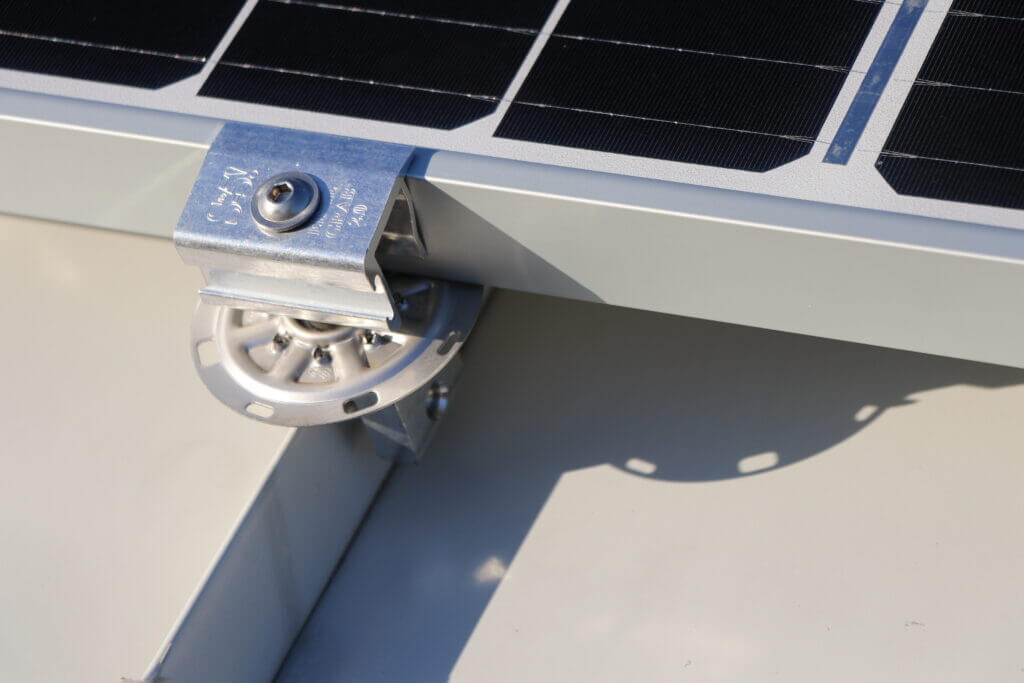
Our mini camps hold UL 2703 certification, the benchmark for solar mounting hardware across North America, yet they sit outside the MCS product database in Britain.
For a UK installer, that gap raises a fair question. If the clamp is good enough for the American standard, why isn't it MCS certified, and does this mean the products are bad?
The answer depends on what you're installing and where.

MCS Is a Whole-System Scheme, Not Just a Product Stamp
MCS stands for the Microgeneration Certification Scheme. It is a government-backed UK initiative to ensure quality and safety across small renewable installations, including solar panels.
The detail people often miss is that MCS works on two levels at once:
· Installers have to be MCS accredited
· Products have to be MCS certified.
For solar mounting, the relevant standard is MCS 012, and its scope is wider than most assume. It doesn't just look at one clamp in isolation. It covers the entire mounting system used to fix panels to a building: the clamps that fix rails to the structure, the brackets that connect rails to the panels, and any other hardware in the assembly. Every component in that chain is in scope.
All the individual components must either be approved by the manufacturer to work together, or declared universally compatible. You cannot mix and match uncertified parts and expect the installation to pass.
What MCS 012 is really testing for comes down to three things a UK roof has to survive: wind uplift, fire safety, and water tightness.
MCS isn't a legal requirement to sell a mounting product in the UK, but it now acts as a prerequisite for products and installers regardless. This is because a large number of financial schemes and incentive programmes require both MCS-certified products and MCS-accredited installers.
The big one is the Smart Export Guarantee, which pays solar owners for surplus energy sent back to the grid. No MCS certificate, no SEG eligibility. That single link is what makes MCS non-negotiable across the UK residential and small commercial sector.
So Where Do S5! Clamps Stand?
They are not currently MCS certified. They were certified before, but that certification has lapsed (for now).
The part worth holding onto is that recertification is actively underway. S5! clamps are expected to regain MCS approval soon. This is a lapse, not a permanent exclusion.
What they hold in the meantime is UL 2703, which is a different kind of credential altogether.
What UL 2703 Brings to the Table
UL 2703 is the definitive safety standard for photovoltaic module mounting systems across the USA and Canada. It tests three core areas: electrical safety, fire safety, and mechanical strength, with load testing for wind uplift, downforce, and lateral forces.
It is a rigorous and respected standard. S5! clamps have been tested against it, which gives installers and engineers documented, third-party evidence of how the hardware actually performs under structural and electrical load.
Two Credible Standards, Two Different Worlds
The temptation is to ask which standard is better. That's the wrong question, because they overlap more than they compete.
Both require third-party testing. Both address mechanical loading, electrical safety, and fire safety. Both are treated as marks of quality in their own markets. The technical ground they cover is largely the same.
The differences are about geographical location and scope of the scheme.
MCS 012 is a UK-only scheme and UL 2703 is North American. There's no formal mutual recognition between them, so a product can pass UL 2703 comfortably and still not qualify for MCS.
Then there's scope. MCS goes beyond the product. It certifies the installer, the installation process, and the finished system as a whole. UL 2703 is purely a product standard. It tells you the hardware has been tested, but it says nothing about who installed it or how.
Why Some UK Installers Still Choose S5!
If MCS is this central, choosing an uncertified clamp sounds reckless. It isn't, and the reason is that not every solar installation lives under the MCS framework.
For domestic installations and small commercial projects that need full-system MCS certification, the line is clear and worth stating plainly: S5! clamps cannot currently be used without putting compliance at risk.
MCS governs small-scale microgeneration, not all solar. Large commercial and industrial rooftop projects run under a different set of rules entirely. A logistics warehouse, a factory, a school on a commercial power purchase agreement, none of these necessarily require MCS certification.
The procurement decisions there are made by structural engineers, insurers, and building surveyors, not by the MCS product directory. What those people want is engineering-grade performance data, and on that measure S5! clamps are exceptionally well-evidenced, backed by UL 2703 and decades of empirical pull-out test data.
Standing seam metal roofs are a specialist problem. S5! was founded in 1991 to solve one specific challenge: attaching equipment to standing seam metal roofs without penetrating them.
No other manufacturer has built the same depth of tested, profile-specific clamp-to-seam data across such a wide range of roof types.
For an installer working on a Kingspan or Steadmans profile, the question usually isn't "is this MCS listed?" It's "has this clamp been pull-out tested on this exact seam, and can I prove it?" S5! can often answer that more directly than any MCS-listed alternative.
Non-penetrating attachment protects the roof warranty. S5! clamps grip the standing seam with precision-torqued setscrews. No drilling, no penetrations, no sealants. That matters because many standing seam roof manufacturers write clauses into their warranties that void coverage the moment the roof is penetrated. In those cases a non-penetrating solution stops being a preference and becomes a contractual necessity.
A Caution for MCS-Accredited Installers
For MCS-certified installers on domestic or small commercial work, everything needs to be MCS certificated. The mounting system has to appear on the MCS Product Integrity Database.
Using an uncertified product, however well-regarded it is internationally, puts the MCS certificate at risk, and with it the customer's access to SEG payments and other scheme benefits.
If you're MCS accredited, check your mounting products against the current MCS MID before you commit to a specification.
The Bottom Line
S5! clamps aren't MCS certified at the moment, and that genuinely rules them out for some UK work. It does not rule them out for all of it.
On large-scale commercial and industrial standing seam roofs, where MCS isn't required, where non-penetrating attachment is contractually essential, and where engineering-grade load data counts for more than a directory listing, they remain one of the most trusted and best-supported solutions on the market.
The path back to MCS certification is already moving. Until it lands, choosing S5! in the UK isn't a reckless call. It's a context-specific one, made by professionals who understand the regulatory landscape and are working comfortably inside it.
If you’re unsure what tools would be best for your cladding project, speak with a cladding expert today to take the next step towards your installation.